Solar Panel Cleaning Safety: What Can Actually Hurt You on a Las Vegas Roof
Short answer: when it comes to solar panel cleaning safety, the biggest danger is the fall, not the panels. In 2011 alone, the CDC counted about 34,000 work-related ladder fall injuries treated in US emergency rooms. The second risk is electrical: panels make power whenever light hits them, even with the system switched off, and damaged panels can give a lethal shock. If you clean your own, stay on the ground, work early in the morning and stop at any sign of damage.
The real risks, ranked
| Risk | Why it matters | How to avoid it |
|---|---|---|
| Falls from ladders and roofs | The CDC counted 113 work-related ladder fall deaths and about 34,000 ER visits in 2011 | Clean from the ground with a pole. Treat the ladder as a last resort |
| Electric shock from damaged panels | REC warns damaged panels can give a lethal shock through leakage current | Look before you touch. Cracked glass, burns or loose wires mean stop |
| Thermal shock | Cold water on hot glass can stress the panel. REC says clean only when panels are cool | Start at first light in summer, with water near air temperature |
| Slipping on wet glass or tile | Wet panels and tile are slick, and tile cracks under the wrong step | Never stand on panels. On tile, step only where tiles overlap |
| Heat on the roof | A Las Vegas summer roof gets far hotter than the air | Work early, drink water and get off the roof well before midday |
| Dust from dried droppings | Old pigeon droppings dry into dust you don’t want to breathe | Wet them first and wear a mask, or leave nest cleanouts to a pro |
Why switching the system off doesn’t make it safe
Turning off the inverter or the disconnect stops power going to your house. It doesn’t stop the panels from making electricity. As long as light hits the glass, there is voltage in the panels and the wiring between them. Trainers at ISCA, the solar cleaning safety group, make the same point: an isolator does not make the roof safe.
On an intact panel, washing the glass side with water is low risk, which is why manufacturers allow it. The danger comes from damage: cracked glass, a burned junction box, melted connectors or wires chewed by pigeons or rodents. Any of those is a job for a licensed solar electrician, not a cleaner.
If you clean your own panels, do it this way
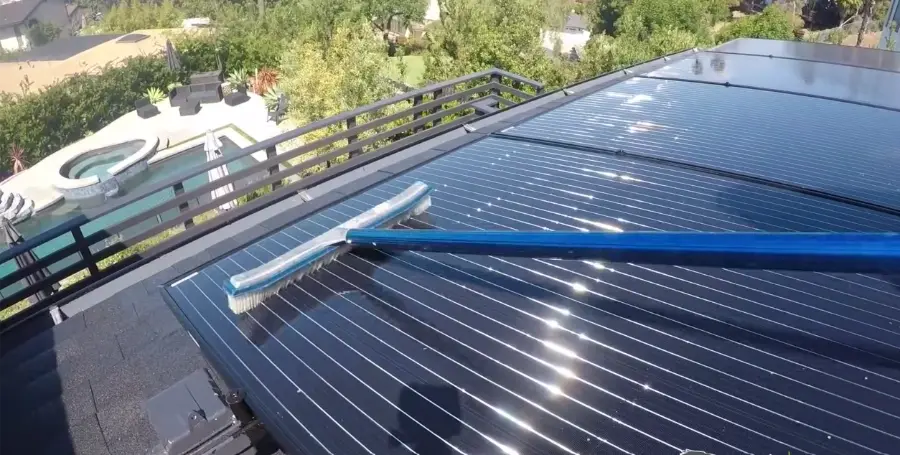
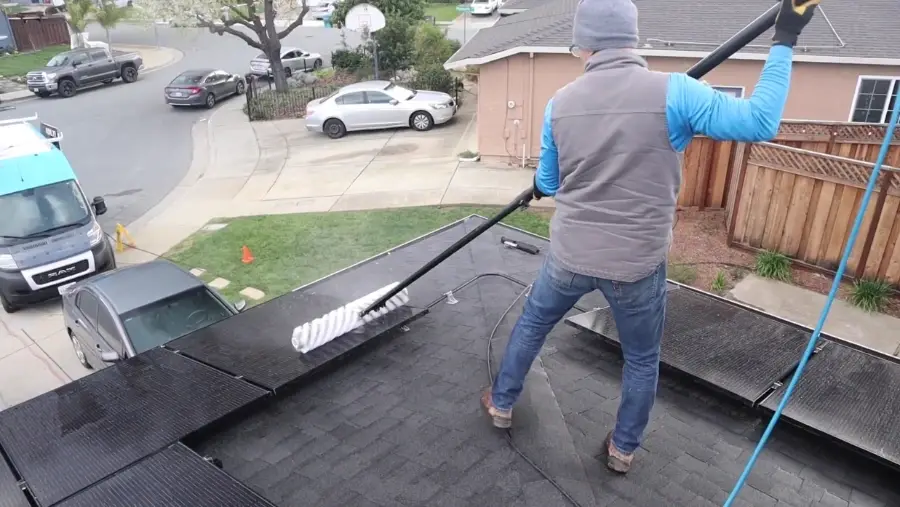
- Stay on the ground. Use a soft brush on an extension pole and a garden hose at normal pressure.
- Go at first light, while the panels are cool, never in the afternoon sun.
- Look at every panel before water touches it. Skip anything cracked, scorched or with loose wires.
- Use plain water, or deionized water if you can get it. No soap that leaves residue, no acids, no pressure washer.
- Keep the water on your property. Southern Nevada fines runoff onto the street.
- Don’t climb onto the roof to reach the top rows. Leave those, or call someone with fall protection.
For the full ground-level method, see can I clean my own panels? on our home page. Tap water here leaves hard water spots, so a hose rinse will rarely look perfect.
Who should skip DIY altogether
- Anyone with a two-story home, or panels you can’t reach from the ground.
- Owners in 55+ communities like Sun City Summerlin, Sun City Anthem and Sun City Aliante. A fall at 70 is a different thing than a fall at 30.
- Homes with concrete or clay tile, where one wrong step cracks a tile. See tile roof solar panel cleaning.
- Anyone with pigeons nesting under the array. The droppings and nest material need careful removal. See bird droppings and nest cleanup.
- Anyone who has spotted damage, burn marks or loose wiring.
Before you hire anyone, ask what they will use, whether they go on the roof, what safety training their crew has and whether they carry insurance. That goes for us too. See residential solar panel cleaning for how a professional visit works, or typical Las Vegas prices.
Solar panel cleaning safety questions
Does turning off my solar system make it safe to clean?
No. It stops power going into your house, but the panels still make electricity whenever light hits them. Intact panels can be washed from the glass side, but damaged ones should be left alone until a licensed solar electrician has checked them.
Is it safe to walk on solar panels?
No. REC tells owners never to stand on, walk on, lean on or press on its panels. Weight on the glass can cause tiny cracks you can’t see, and wet glass is slippery.
Can cold water crack hot solar panels?
It can stress them. Panel makers warn about thermal shock and say to clean only when panels are cool, with water close to their temperature. LONGi gives a limit of 10°C between the water and the panel.
What should I wear to clean solar panels from the ground?
Closed shoes with good grip, eye protection and sun protection. ISCA safety trainers point out that thin latex gloves can make electrical burns worse, which is one more reason to leave any panel that looks damaged alone.
Is it safe to clean solar panels in summer?
Only very early in the morning. By late morning a Las Vegas roof and the panels on it are hot enough to risk thermal shock to the glass and heat illness for you. If you can’t finish by mid-morning, stop and come back another day.
Rather stay off the roof?
Tell us your panel count, one or two stories and your roof type. We will reply with a price, or tell you if the panels can wait.
Sources: CDC: occupational ladder fall injuries, REC cleaning guide, LONGi O&M manual, SNWA water waste. Updated October 2026.