Does Rain Clean Solar Panels in Las Vegas? What 4 Inches a Year Can and Can’t Do
Short answer: sometimes, but not often. A rain of about 0.2 inches or more rinses off loose dust, and UNLV found that size of storm partly restores output. Las Vegas only averages about 4.18 inches of rain a year, so those storms are weeks apart. Rain does nothing for bird droppings, and a light shower often leaves panels spotted or streaked instead of clean.
How much rain Las Vegas actually gets
People in rainy places can let the weather do the cleaning. So does rain clean solar panels in Las Vegas? The numbers say not often enough to count on. These are the official National Weather Service figures for Las Vegas, plus the UNLV threshold for when rain starts to help.
| Measure | Las Vegas figure | What it means for panels |
|---|---|---|
| Normal yearly rain (1991 to 2020) | 4.18 inches | Averaged over the year, about a third of an inch a month |
| Days with any measurable rain | About 26 a year | Most of these are too light to rinse anything |
| Days with 0.10 inches or more | About 11 a year | Most are still below the 0.2 inches UNLV found was needed |
| Days with 0.50 inches or more | About 2.5 a year | The storms most likely to rinse panels well |
| Rain needed to partly restore output | At least 0.2 inches | From a UNLV study of campus solar panels |
| Typical gap between 0.2-inch storms | About 52 days at the median | Based on 29 years of Las Vegas rain data in the same UNLV study |
The day counts are 1981 to 2010 normals from the NWS Las Vegas office; the yearly total is the newer 1991 to 2020 normal. Rain comes from winter storms and from short, heavy July to September monsoon storms, and the monsoon storms often bring dust with them.
What rain washes off, and what it leaves behind
| On the glass | Does rain clean it? |
|---|---|
| Loose desert dust on a tilted panel | Yes, if the storm is 0.2 inches or more |
| Fine, stuck-on dust film | Only partly |
| Bird droppings | No. They dry hard and bond to the glass |
| Pigeon nests and debris under the array | No. Nests have to be removed by hand |
| Hard water spots from sprinklers or a hose | Usually not. The minerals bond as they dry |
| Mud streaks from a dusty monsoon storm | No. Rain is often what made them |
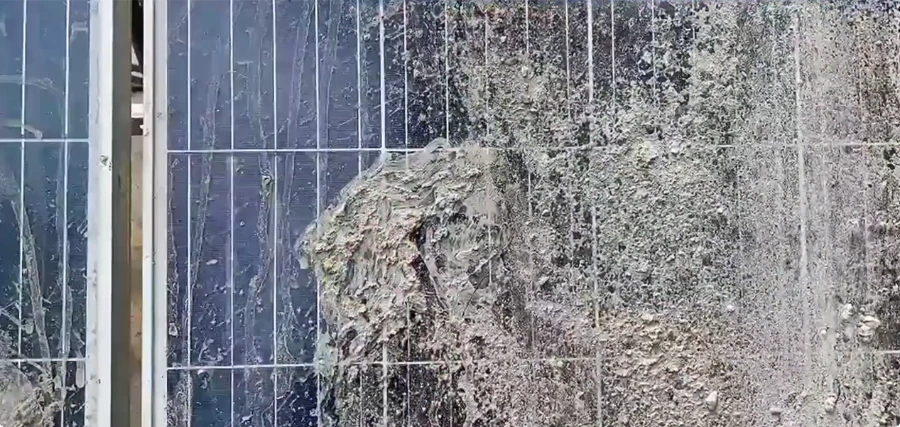
That is why owners on Reddit keep saying the same thing: rain takes care of dust, but not droppings. If you have pigeons, the rain will never catch up. See bird droppings cleanup and pigeon proofing for the fix.
Why a light shower can leave panels looking worse
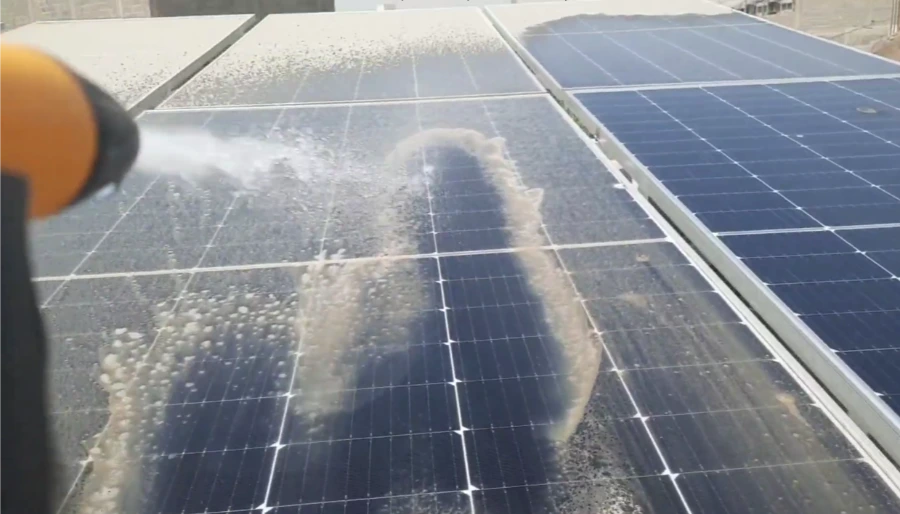
A short sprinkle wets the dust without carrying it off. As the drops dry, the dust collects into spots and streaks, and on a hot roof that happens fast. Rain that falls through dusty air during a monsoon storm can land as muddy water to begin with.
Flat and low-tilt panels hold the water
Panels need a slope of at least about 10 degrees for rain to run off instead of pooling at the bottom edge of the frame, according to SolarQuotes. Below that, water sits along the lower edge and leaves a band of dried dirt behind. SolarQuotes also reports that Google found dirt halved the output of panels mounted flat on its carports after 15 months. Low-slope roofs, patio covers and carports in Las Vegas see the same problem.
Rain totals alone don’t predict cleaning
Solar models often treat any day above a set rainfall amount as a cleaning event. Sandia’s description of the widely used Kimber model, for example, uses a 3 mm example threshold. But a 2021 study from Spain’s Plataforma Solar de Almería found that rain totals alone describe natural cleaning poorly. How dirty the panel was, wind-driven rain direction, panel angle and the type of dirt all change how much a storm actually removes.
What the UNLV study found, and where it stops applying
The UNLV thesis tracked solar arrays on the university campus. During dry spells, output dropped by only thousandths of a percent per day. A professional wash of one array produced a very small gain, and the author concluded that washing wasn’t worth it for those arrays, since a rain of 0.2 inches or more could restore much of the loss.
We agree with that for the same situation: clean, tilted panels with light, even dust. It stops applying when something on the glass doesn’t rinse off. Droppings, nests, mineral spots from sprinklers, and dirt bands on flat panels are why most Las Vegas homes eventually need a cleaning. Our is solar panel cleaning worth it guide runs the dollar math, and how often to clean solar panels has a free schedule checker.
After a storm: a 5-minute check before you book anything
- Wait two or three clear, sunny days so you are comparing like with like.
- Open your monitoring app and compare a clear day now with a clear day in the same month last year. Allow about half a percent a year for normal aging.
- Look at the panels from the yard or an upstairs window. Do you see white droppings, streaks or a dirty band along the bottom edge?
- Listen for pigeons at sunrise and look for droppings on the patio or pool deck.
- If output matches and the glass looks even, let it be. If output dropped or you can see droppings or mud, that is when a cleaning pays.
If a dust storm or monsoon left heavy mud, read cleaning after dust storms and monsoon. And please don’t climb up to hose them off: tap water here averages about 280 ppm hardness and leaves hard water spots, and Southern Nevada fines water running off a property.
Does rain clean solar panels? More questions
Does rain clean bird droppings off solar panels?
No. Droppings dry hard and stick to the glass, and even a big storm usually leaves them in place. They can also shade cells enough to cause hot spots, so they are worth removing by hand with soft tools and plain or deionized water.
Should I clean my solar panels before or after the monsoon?
After. Cleaning in June only to have July storms leave mud on the glass wastes the visit. Spring is the main cleaning, and a second one after monsoon season makes sense only if storms left mud or streaks.
Why do my solar panels have spots after it rained?
Light rain wets the dust without washing it off, and the dust dries into spots where each drop sat. A heavier rain, or a cleaning with deionized water, clears it. Spots that stay after a heavy rain may be mineral spots from sprinklers or a hose instead.
Do solar panels still work when it rains?
Yes, but they make less power because clouds block much of the sunlight. Rain itself doesn’t harm panels that are in good condition. Output should return to normal on the next clear day.
Can I collect rainwater to clean my solar panels?
You could, since rainwater is low in minerals, but Las Vegas gets so little that most owners won’t have enough on hand. Any water you use should be at air temperature, used early in the morning while the panels are cool, and kept from running off your property.
Rain didn’t do the job?
Tell us your panel count, roof type and what you see on the glass. If one more storm would do it, we will tell you to wait.
Sources: UNLV rainfall study, NWS Las Vegas 1991-2020 normals, NWS days with precipitation, SolarQuotes on low-tilt panels, Sandia PVPMC: Kimber soiling model, Hanrieder et al., ISES 2021. Updated October 2026.