Pigeon Proofing Solar Panels in Las Vegas
Pigeons nest in the gap under rooftop panels all over the valley. We clean out what we can reach, wash the panels, and seal the gap with no-drill steel mesh so they cannot move back in.
Why do pigeons nest under solar panels?
Rooftop panels sit a few inches above the roof. That gap gives pigeons shade from the desert sun, shelter from wind and predators, and a flat spot to build on. One homeowner told a Las Vegas TV station the panels sit off the roof “about like four inches,” which is plenty of room for a nest.
KTNV reported on a Summerlin family who had panels installed at the start of the year and were soon sweeping droppings off their pool deck, trampoline and backyard every day. A local pest-control pro told the station droppings can pile up to 150 pounds where roof sections meet in a V. The family said nobody offered pigeon-proofing when the panels went in.
Signs pigeons are living under your panels
- Cooing on the roof at sunrise
- Fresh droppings on the patio, pool deck or driveway, day after day
- Birds landing on the roof and disappearing under the edge of the array
- Feathers, twigs or nest material poking out from under the panels
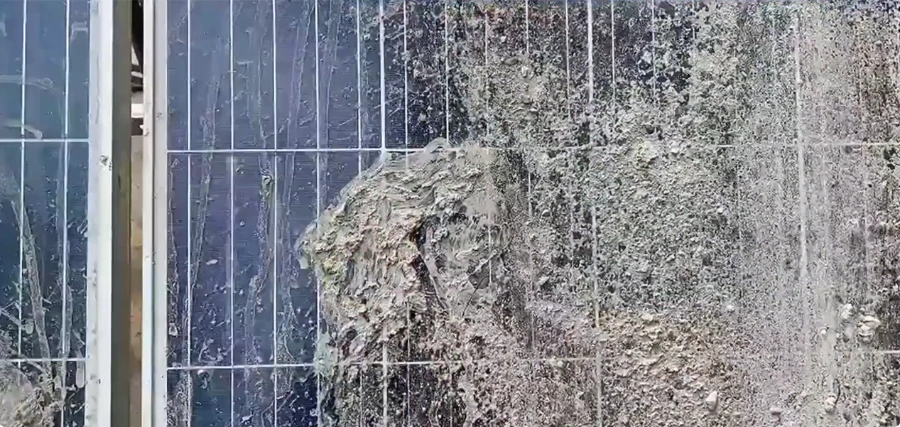
- Droppings streaked down the panel glass
What pigeons do to your solar system
- They cut output. A dropping fully blocks the cells under it. Cells are wired in rows, so one blocked row can cut a panel’s output by roughly a third, according to solar cleaning safety trainers at ISCA, and one weak panel drags down the rest of its string.
- They build up on the roof. Nests, feathers and droppings collect around wiring, mounts and roof tiles under the array, where nobody sees them until there is a lot.
- They make a mess of your yard. Daily droppings on pools, patios and cars are often the first sign homeowners notice.
- They carry germs. Pigeon droppings are known to carry disease, which is why pest-control companies clean nests with HEPA vacuums and breathing protection.
How we pigeon-proof a solar array
- Inspect. We check how many panels you have, how birds are getting in, and how much nesting is already there.
- Clean out. We remove the nests, droppings and feathers we can safely reach from the panel edges.
- Wash the panels with deionized water and soft brushes, so the glass starts clean.
- Install mesh. We clip PVC-coated steel mesh to the panel frames around the full perimeter. No drilling into your roof or panels.
- Close the gaps. We check corners, seams, conduit runs and uneven tile lines, where birds try to squeeze back in.
- Photo report. You see the before, the after, and anything we could not reach.
An honest limit: if birds have nested for years, some debris sits deep under the array where nobody can reach it without lifting panels. Removing panels is a job for a licensed solar contractor. We will tell you before we start if your roof needs that.
Mesh vs spikes vs netting: what actually works
| Option | What it does | Does it stop nesting under panels? |
|---|---|---|
| Perimeter mesh (critter guard) | Closes the gap between the panel edge and the roof | Yes. It blocks the only spot pigeons nest |
| Bird spikes | Stops birds perching on ledges and rooflines | No. Birds still walk under the panels |
| Netting or chicken wire | Loose barrier draped over gaps | Not for long. Desert sun and wind sag and tear it |
| Fake owls and scare tape | Visual scare | No. Pigeons get used to them |
Local companies back their mesh with long warranties: one offers 10 years on critter guards, others advertise lifetime guarantees. Whoever you hire, get the warranty terms in writing, including what happens if a section comes loose.
How much does pigeon proofing cost in Las Vegas?
Expect several hundred to a couple of thousand dollars. One Las Vegas company advertises a $1,199.99 package, and a solar cleaner on Reddit reported a range of about $750 to $2,500. What sets the price:
- Array size and the total length of panel edge that needs mesh
- Roof height and type, since two-story and tile roofs take longer
- Cleanup. A prevention install with no nests is the cheapest version of the job. Years of nesting cost more to clear.
- Gaps and layout, such as multiple arrays, conduit runs and uneven tile lines
Getting it done before birds settle in is the cheapest route. See the full solar panel cleaning cost guide for cleaning prices.
Pigeon proofing FAQs
Does pigeon mesh damage solar panels or void the warranty?
Clip-on mesh attaches to the panel frames without drilling into the roof or the panels, which is why it is the method professionals use. Drilling, screws through the frame or wire twisted around cables are what cause problems. Ask any installer exactly how their mesh attaches.
Can pigeons get back in after mesh is installed?
Not if the perimeter is sealed properly. Birds find gaps at corners, conduit runs and uneven tile lines, so those spots get the most attention. A good installer will come back and fix any section that comes loose.
Do you remove the pigeons?
We remove nests, droppings and debris we can reach, then block access. The mesh keeps birds from returning under the panels. Pigeons are not harmed in the process.
Is cleaning included with pigeon proofing?
Yes. Panels are washed with deionized water after the cleanout, so the array starts clean once the mesh is on.
How long does pigeon proofing take?
Most homes are done in one visit. Big arrays, two-story roofs and heavy nesting take longer than a prevention install on a clean roof.
Should I install mesh even if I do not have pigeons yet?
If neighbors on your street have pigeon problems, prevention is the cheapest time to do it, since there is no nest cleanup. If nobody nearby has birds, you can wait and watch for the signs.
Get the birds out for good
Send us your panel count and a photo of the roof if you can. We will quote the cleanout, wash and mesh together.
Sources: KTNV, Sinclair Broadcast Group, Progressive Pest Control, Best Shine warranty. Updated October 2026.