How Often to Clean Solar Panels in Las Vegas, and When to Skip It
Short answer: for most Las Vegas homes, once a year in spring is enough. Add a second visit after monsoon season only if storms left mud on the glass, pigeons moved in, or you live next to construction or open desert. Before you book anyone, compare your clear-day output with the same month last year. If it matches, you can wait, whatever a door-knocker says.
Check how often your panels need cleaning
Answer four quick questions about your roof. The checker suggests a yearly schedule and tells you whether to clean now or wait.
This is a rule of thumb built from the research on this page, not a measurement of your roof. Your monitoring app is still the best judge.
What the research says about cleaning frequency
| Source | What it found | What it means for you |
|---|---|---|
| UNLV study of campus solar panels | Soiling losses during dry spells were only thousandths of a percent per day. It took at least 0.2 inches of rain to partly restore output, and a rain that size came about every 52 days at the median. | Dust builds slowly, and rain rarely cleans for you. That points to a yearly schedule, not a monthly one. |
| Jinko Solar engineer | Once a year in spring is typical for most homes, with early-morning washing in plain water. | Spring timing gets panels clean before the highest-production months. |
| Owner in a Reddit thread on Las Vegas panels | About a 4% drop over three years without washing. | Light dust alone often isn’t worth paying to remove every year. |
| ISCA safety training | Panels lose about 0.5% a year to normal aging, and droppings that shade one row of cells can cut a panel’s output by about a third. | Take aging off before you blame dirt, and treat droppings as the real reason to clean. |
| NREL figures, as cited by homeowners on Reddit | Total yearly upkeep for a home system runs about $30 per kW, roughly $210 for a 7 kW system. | That budget covers all maintenance, so three paid cleanings a year would blow past it. |
Put together, the numbers say the same thing: Las Vegas dust is steady but slow, droppings and mud are the fast problems, and most homes are best served by one good cleaning a year plus a second one only when something specific shows up. If you want the dollar math for your own system, see is solar panel cleaning worth it, and for the full rain numbers, does rain clean solar panels.
When once a year is enough, and when it isn’t
Once a year is usually enough if
- Your panels sit on a normal pitched roof
- There is no active construction or open desert nearby
- You don’t see droppings or hear pigeons at dawn
- Clear-day output stays close to the same month last year
Plan on two or more if
- Panels sit nearly flat on a low-slope roof, common in older mid-century homes
- You live next to graded lots, like the newer parts of Enterprise or Centennial Hills
- Pigeons nest under the array. Fix that with pigeon proofing first
- A monsoon storm left mud streaks on the glass
The best time of day to clean solar panels
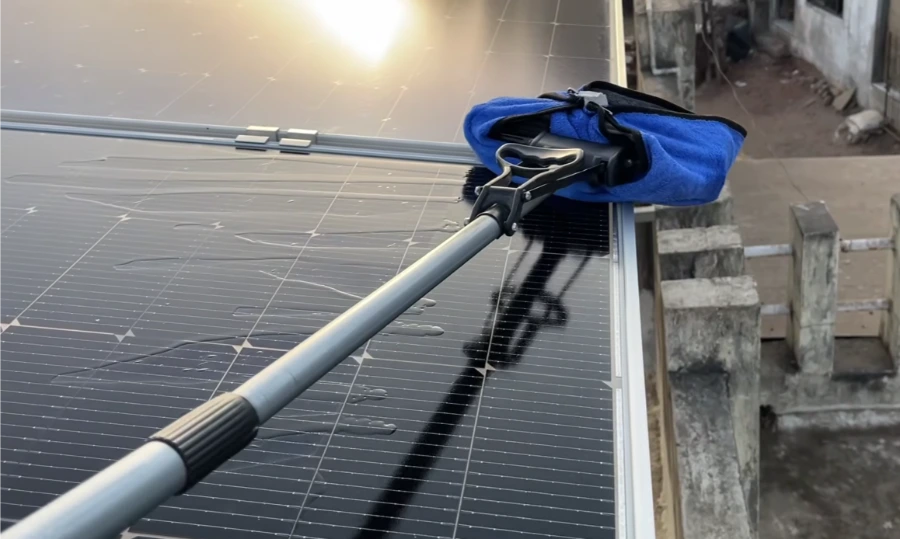
Early morning, while the glass is still cool. LONGi’s maintenance manual says the water and the panel should be within 10°C of each other, and suggests cleaning in the early morning, at dusk or on cloudy days when sunlight is weak. REC says to clean only when panels are cool, to avoid thermal shock, and to use water at ambient temperature.
In a Las Vegas summer that means starting at first light. By midday a dark panel can be far hotter than the air, and cold water on hot glass is exactly what the panel makers warn against. Afternoon washing also makes hard water spots worse, because tap water flash-dries on hot glass.
The best time of year
Spring, before the long, high-production summer days, then again after monsoon season only if it left mud. Winter is a good time for inspections and pigeon mesh, when roofs are cool. The full month-by-month calendar is on our solar panel maintenance plans page.
Do you really need three cleanings a year?
Probably not. Door-to-door cleaners around the valley often tell every house on the street it needs three cleanings a year, without looking at anyone’s production numbers. Some homes do: a nearly flat array next to a building site with pigeons underneath can need that many. Most don’t.
A fair company will ask what your monitoring app shows before it sells you a schedule. If your output is close to last year, you should hear “wait” from us too. When you do book, typical Las Vegas prices run about $100 to $250 a visit for most homes, and you can see how a visit works on our residential solar panel cleaning page or go back to our Las Vegas solar panel cleaning home page.
How often to clean solar panels: more questions
Can you clean solar panels too often?
With deionized water and a soft brush, frequent cleaning won’t hurt the glass, but it wastes money. The real risk comes from harsh methods: abrasive pads, pressure washers and strong chemicals can wear the anti-reflective coating, and doing that more often only adds up the damage.
Should I clean my solar panels in winter?
Usually not. The sun is lower, days are shorter and production is at its yearly low, so a dirty panel costs you less. Winter is a better time for an inspection or pigeon mesh, then a cleaning in spring.
How often should I check my monitoring app?
A quick look once a month is plenty. Compare a clear, sunny day with a clear day in the same month last year, allow about half a percent a year for normal aging, and look closer only if the gap grows.
Do brand-new solar panels need cleaning?
Rarely in the first year, unless pigeons find them or you live beside active construction. Many newer homes in the northwest and southwest valley go a full year or more before output drops enough to matter.
Does my panel warranty require regular cleaning?
Most panel warranties do not set a cleaning schedule, but manuals do say how to clean: plain or deionized water, soft tools, cool panels and no pressure washer. Check your own manual, since the method matters more than how often.
Not sure it’s time yet?
Tell us your panel count, roof type and what your monitoring app shows. If a cleaning won’t pay off yet, we will tell you.
Sources: UNLV (Tanaka) campus soiling study, LONGi O&M manual, REC cleaning guide, KTNV pigeons under solar panels, LVVWD 2026 water quality summary. Updated October 2026.